
Reviews
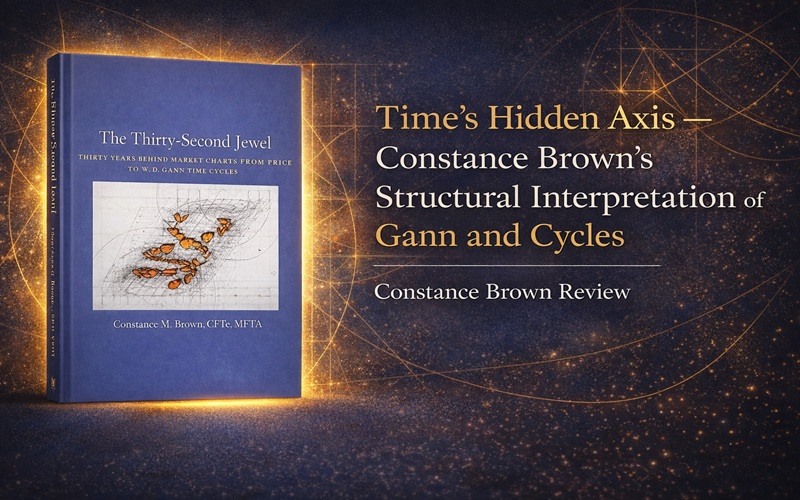
Time’s Hidden Axis — Constance Brown’s Structural Interpretation of Gann and Cycles
Introduction
Constance Brown’s The Thirty-Second Jewel occupies a distinctive place in modern Gann scholarship. Unlike purely geometric or purely astrological interpretations, Brown approaches W.D. Gann’s legacy through the lens of structural cycle theory and multidimensional market alignment. Her work does not attempt to mystify Gann; rather, it seeks to decode the deeper architecture of market movement—particularly the intersection of price symmetry, time harmonics, and planetary influence. Brown’s thesis suggests that Gann’s greatest insights were not confined to angles or number squares alone, but embedded within a broader structural framework of time relationships that repeat across markets and eras.
The Foundation
At its core, The Thirty-Second Jewel is grounded in the belief that markets are governed by rhythmic laws that extend beyond visible price swings. Brown begins by revisiting Gann’s principle that time is the most important factor in forecasting. However, she expands this into a more structured framework—one that integrates astronomical cycles, intermarket relationships, and harmonic sequencing.
Her foundational premise rests on the idea that major market reversals often occur when multiple independent cycles converge. This convergence is not random coincidence but structural alignment. Brown treats planetary cycles not as symbolic astrology, but as timing mechanisms—external clocks that correlate with internal market behavior. The “Thirty-Second Jewel” metaphor itself reflects the notion of a hidden structural key—an overlooked timing dimension that connects Gann’s geometric methods with cyclical planetary motion.
Core Concepts and Analytical Structure
Brown’s analytical structure revolves around several primary subjects that define her methodology. The first subject is cycle convergence. She demonstrates that markets are influenced by overlapping cycles of varying magnitudes—short-term trading rhythms, intermediate-term swing cycles, and long-term secular cycles. When these cycles synchronize, volatility intensifies and trend direction becomes vulnerable to reversal.
The second subject is intermarket resonance. Brown explores how different asset classes—equities, bonds, commodities, currencies—often move in correlated cyclical relationships. These relationships form structural feedback loops that can amplify or dampen primary trends. A third central concept is planetary timing integration. Brown examines how planetary alignments and astronomical cycles can correspond with inflection points in financial markets. Unlike traditional astro-trading frameworks that rely heavily on projection, Brown emphasizes confirmation through price structure. Planetary timing becomes a filter, not a standalone trigger.
The fourth subject is price–time symmetry. Brown revisits Gann’s idea that price and time must balance. She studies repeating temporal intervals between highs and lows, examining whether duration symmetry aligns with structural turning points. This integration reinforces her thesis that timing relationships precede visible price shifts. Finally, Brown highlights multidimensional structure—the understanding that markets operate simultaneously across price, time, and psychological expectation. Her framework seeks to unify these dimensions into a coherent interpretive model.
Application and Practical Interpretation
In practical terms, Brown’s methodology encourages traders to monitor structural alignment rather than isolated signals. The focus shifts from predicting specific prices to identifying time windows where structural pressure increases. Her approach is particularly relevant for macro traders and swing analysts. By mapping cycle convergence zones and observing intermarket behavior, traders can anticipate periods of instability or acceleration. Planetary timing overlays are used conservatively—only when supported by structural price confirmation.
One of Brown’s practical contributions is teaching traders to distinguish between ordinary retracements and structurally significant reversals. When price action aligns with time symmetry and broader cyclical convergence, probability shifts meaningfully. Her framework also integrates smoothly with modern analytical platforms, allowing traders to combine cycle studies with classical technical tools such as momentum divergence, trendline breaks, and volatility expansion.
Analytical Reflection
Constance Brown’s contribution lies in her disciplined synthesis. She neither isolates geometry from cycles nor cycles from planetary timing. Instead, she constructs a layered system where each component reinforces the others.
Unlike purely geometric analysts such as Gilmore or Jenkins, Brown places stronger emphasis on cyclical rhythm and macro synchronization. At the same time, she avoids speculative astro claims by insisting on structural confirmation. Her work reflects a broader philosophical alignment with Gann’s original worldview: that markets are governed by natural law, and that these laws express themselves through time first, price second. In this sense, Brown restores temporal primacy to Gann’s legacy.
Conclusion and Further Study
The Thirty-Second Jewel expands the study of Gann beyond angles and number squares into a multidimensional exploration of time, structure, and planetary rhythm. It challenges traders to think in terms of alignment rather than reaction, and convergence rather than coincidence.
For serious students of Gann methodology, Brown’s work provides an advanced framework for understanding how cyclical forces intersect with geometric structure. It stands as an important bridge between traditional Gann geometry and modern cycle integration. Further studies in geometric price levels, planetary timing models, and structural cycle synchronization can be explored at GannMastery.com, where the deeper dimensions of time–price analysis continue to be developed.
Reference
Constance Brown, The Thirty-Second Jewel.