
Gann Vault
The Ticker and Investment Digest – Interview with W.D. Gann (1909)
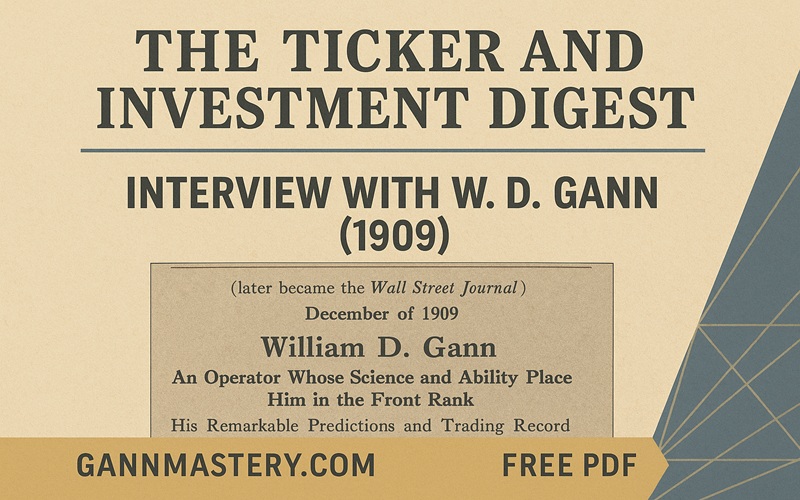
The Ticker and Investment Digest, published in December 1909, remains one of the most important historical documents ever written about W.D. Gann. This original feature marked Gann’s first public recognition as a financial visionary whose discoveries transformed speculative science. The article — later reprinted in what became The Wall Street Journal — documented his extraordinary trading accuracy, verified performance, and revolutionary concept known as the Law of Vibration.
In this interview, Gann explains how all market movements are governed by universal natural laws. After a decade of research, he concluded that stocks and commodities vibrate at specific mathematical frequencies, creating recurring cycles of activity and rest. By identifying these harmonic relationships — between price, time, and energy — Gann claimed he could forecast market turns with astonishing precision. His 1909 demonstrations, witnessed and recorded by The Ticker, reported 286 trades with 264 profitable — a verified accuracy rate exceeding 92%.
The article outlines how Gann’s forecasts on stocks such as Union Pacific, U.S. Steel, and wheat prices came true to the exact eighth of a point and to the precise day predicted. It also reveals his disciplined philosophy: speculation as a science governed by proportion, causation, and periodic law. Through this work, Gann demonstrated that “there is no chance in nature,” and that market behavior follows the same vibratory harmonics seen in physics and astronomy.
For traders and researchers of Gann’s geometry, cycles, and time analysis, this 1909 publication is indispensable. It represents the genesis of his lifelong pursuit — the mathematical unification of natural law and financial market behavior — and stands as a cornerstone of modern Gann theory.