
Articles
Mapping the Invisible Dimensions of Time: Bradley Cowan’s Four-Dimensional Market Geometry

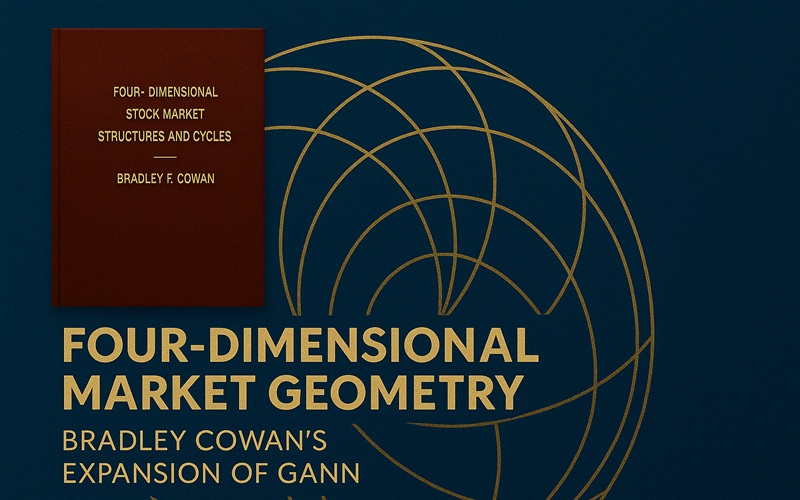
In the pantheon of market geometry, few works have expanded W.D. Gann’s legacy as boldly as Bradley F. Cowan’s Four-Dimensional Stock Market Structures and Cycles.
This book stands at the intersection of physics, mathematics, and financial analysis, revealing an astonishing hypothesis: that markets move not merely through price and time, but through four interacting dimensions of motion and resonance. Cowan’s research is both architectural and metaphysical—an exploration of how space, energy, and vibration shape the behavior of markets over time.
The Foundation — Extending Gann’s Framework into Space-Time:
Cowan begins where Gann left off.
While Gann’s geometry primarily expressed the relationship between price and time on a two-dimensional chart, Cowan proposes that this is only a projection of deeper, multidimensional motion.
Drawing upon physical analogies from relativity and wave mechanics, he demonstrates that market movements obey laws of angular momentum, torque, and harmonic resonance—terms borrowed from mechanics but reinterpreted through financial data.
The author’s diagrams (especially those on pages 12–25) illustrate conic rotations, spirals, and helical price paths. These are not artistic metaphors but literal geometric representations of energy in motion. Just as planets trace ellipses around the Sun, Cowan argues, prices orbit equilibrium points governed by hidden gravitational ratios—mathematical constants appearing in Gann’s work, such as 1/8, 1/3, 1/2, and phi (1.618).
Core Concepts and Analytical Structure:
The essence of Cowan’s theory is the four-dimensional coordinate system integrating price, time, amplitude, and phase. Each market structure, he claims, exists within a space where cycles rotate in harmonic relationship, forming what he terms “vibrational lattices.”
Key components include:
- Rotational Time Fields – Cycles that spiral rather than repeat linearly; their intersections define “time clusters” of turning points.
- Geometric Resonance Models – Spatial forms (tetrahedral and cubic) corresponding to recurring price ratios observed across instruments.
- Energy Transfer Dynamics – Analogous to physical systems where energy migrates between axes; in markets, momentum alternates between price movement and temporal compression.
- Fractal Symmetry – Larger market cycles replicate the geometry of smaller ones, forming a self-similar, holographic pattern.
By plotting prices within this four-dimensional matrix, Cowan reconstructs entire bull and bear phases as energy waves, each with identifiable amplitude and phase angles. His work redefines Gann’s squares and angles not as static charts but as shadows of dynamic spatial systems.
Application and Practical Interpretation:
Although deeply theoretical, Cowan’s methods have concrete trading implications. He provides algorithms for mapping market structures through rotational time projections and energy vectors. In one case study (pages 87–92), he demonstrates how U.S. Steel’s historical price swings conform to geometric arcs separated by 90-degree time rotations—confirming that turning points emerge where energy vectors realign.
Cowan’s “cycle clusters” identify recurring intervals—90, 180, 270, and 360 trading days—mirroring planetary harmonics in both astronomy and acoustics. He extends this idea into the notion of “vibrational interference”: when multiple cycles coincide, volatility spikes; when they diverge, markets drift. To Cowan, trading discipline means learning to read these wave interactions, not to predict randomness.
Modern analysts will recognize the compatibility between Cowan’s framework and chaos theory. Where Gann hinted at sacred geometry, Cowan provides the equations. His work transforms metaphysics into measurable structure, allowing markets to be studied like physical systems driven by resonance and damping.
Analytical Reflection:
Bradley Cowan’s contribution lies in his courage to treat markets as natural phenomena. He transcends the usual boundary between financial analysis and scientific modeling, asserting that geometry is not merely descriptive but causal. In this view, market cycles are not human inventions—they are expressions of universal vibration.
Unlike many Gann interpreters, Cowan grounds every concept in empirical observation. His calculations show that geometric ratios persist across commodities, indices, and decades. At the same time, he never loses sight of Gann’s spiritual insight: that time and motion are governed by immutable law. In fusing mathematics with metaphysics, Cowan achieves what Gann himself sought—the union of science and spirit through geometry.
Conclusion and Further Study:
Four-Dimensional Stock Market Structures and Cycles challenges readers to rethink the market as a dynamic universe rather than a chart of random prices. It transforms Gann’s two-dimensional tools into a living architecture of motion—one that bridges physics, finance, and consciousness. For advanced students of Gann theory, this work is a revelation: complex, demanding, but profoundly rewarding.
Traders and researchers who wish to explore the practical side of Cowan’s geometry and time-cycle projections can access complementary studies and visual modules at GannMastery.com, where the disciplines of geometry, vibration, and cycle science converge for modern markets.
– Reference: Bradley F. Cowan, Four-Dimensional Stock Market Structures and Cycles.