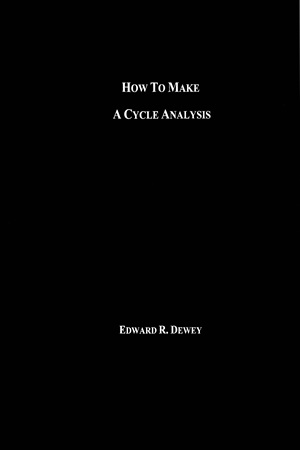
How to Make a Cycle Analysis: Correspondence Course for the Foundation for the Study of Cycles
59.44 $
🎯Core Cocepts:
- Statistical Cycles
- Harmonic Analysis
- Periodic Tables
How To Make A Cycle Analysis is a comprehensive statistical correspondence course developed by Edward R. Dewey for the Foundation for the Study of Cycles. The work presents a structured methodology for identifying, isolating, measuring, and projecting cyclical behavior within economic, financial, and natural phenomena through quantitative analysis.
Rather than approaching cycles from a speculative or purely theoretical perspective, Dewey builds a rigorous framework rooted in statistical discipline, trend isolation, periodicity measurement, moving averages, harmonic decomposition, and time-series projection. The course progresses systematically from elementary statistical foundations into advanced cycle analytics, including periodic tables, time charts, harmonic analysis, periodograms, weighted moving averages, sine-cosine curve fitting, and methods for separating overlapping cycles.
Central to the methodology is the concept that cyclical movement can be extracted from numerical data through proper elimination of distortion, trend, and randomness. Dewey emphasizes that trend must first be isolated before true cyclical structure can be measured accurately. The material repeatedly reinforces repeatability, rhythmic fluctuation, and proportional recurrence as essential principles underlying cycle analysis.
The course also introduces practical analytical procedures for detecting hidden cycles, determining cycle significance, refining cycle length, projecting future turning points, and validating statistical reliability. Although not written specifically for speculative trading, the framework provides a foundational methodology directly applicable to market cycle forecasting, long-wave economic studies, and time-based analytical research in the tradition of structured cyclical investigation.
What You’ll Learn
This course teaches a disciplined statistical process for constructing complete cycle studies from raw numerical data through projection and validation. Readers learn how to transform unorganized time-series information into measurable cyclical structures capable of analytical forecasting.
Core areas of study include:
- Detection and extraction of cyclical movement from data series
- Construction and interpretation of time charts and periodic tables
- Trend isolation and removal prior to cycle measurement
- Application of moving averages and weighted moving averages
- Harmonic analysis and cycle combination techniques
- Use of logarithms, percentages, ratios, and moving differences
- Identification of dominant and hidden periodic structures
- Construction of periodograms and sine-cosine curve fitting
- Positioning and definitizing cycles for timing analysis
- Statistical testing for cycle significance and reliability
- Projection of trend and cyclical behavior into future periods
- Separation of overlapping cycles through periodic tabulation methods
The text also develops the procedural discipline required for rigorous cycle research. Dewey repeatedly emphasizes precision in data handling, chart preparation, and numerical interpretation. Considerable attention is given to reducing random distortion and avoiding premature conclusions derived from incomplete cyclical evidence.
By the later sections of the course, readers are capable of building full harmonic cycle models using multiple cyclical components simultaneously, allowing for advanced forecasting and recurrence analysis. The methodology is particularly valuable for researchers interested in long-duration economic cycles, market timing structures, recurring statistical behavior, and mathematically grounded cycle projection techniques.
How to Make a Cycle Analysis: Correspondence Course for the Foundation for the Study of Cycles By Edward R. Dewey
| Author | Edward R. Dewey |
|---|---|
| Pages | 638 |
| File Types |
Related products