
Articles
The Market’s Hidden Pulse: Interpreting Tony Plummer’s Vision of Gann’s Law of Vibration

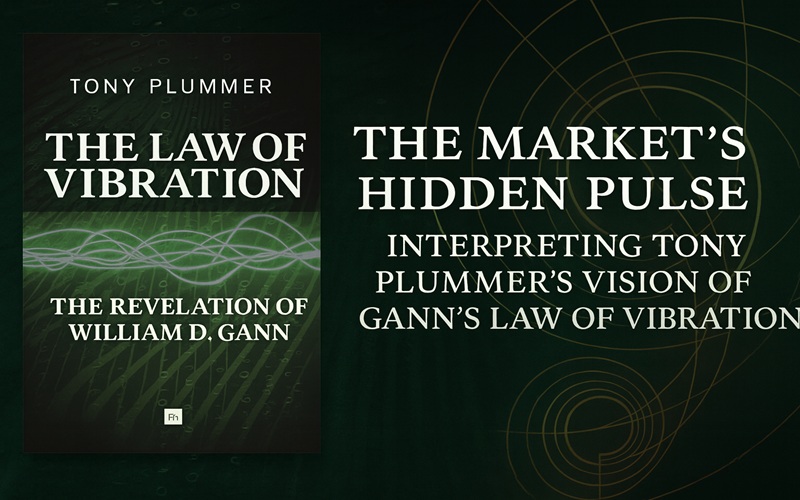
Few modern authors have approached W.D. Gann’s work with the intellectual depth and economic realism of Tony Plummer. In The Law of Vibration: The Revelation of William D. Gann, Plummer seeks to decode the philosophical and mathematical system that Gann claimed underpinned all market movement. Rather than treating Gann as a mystic, Plummer interprets him as a visionary economist whose insights anticipated modern complexity theory, chaos mathematics, and behavioral finance.
Introduction
Plummer begins with a premise that has long intrigued traders: if financial markets appear chaotic, why do recurring patterns of rhythm and proportion persist? He contends that Gann’s so-called “Law of Vibration” is not a metaphor but a scientific principle describing the oscillation of collective psychology through time and price. To understand Gann’s legacy, Plummer argues, one must grasp vibration not as mysticism, but as feedback within a dynamic system—a concept shared with physics, biology, and modern economics.
By anchoring Gann’s philosophy in contemporary scientific thought, Plummer gives new credibility to what many dismissed as numerological speculation.
Core Ideas and Analytical Framework
Plummer’s interpretation rests on three interrelated dimensions: Energy, Rhythm, and Structure. He describes energy as the market’s emotional intensity; rhythm as the temporal pattern of expansion and contraction; and structure as the geometric pattern left on the price chart. Together, these form the vibrational matrix of market behavior.
Drawing parallels between Gann’s “squares,” “angles,” and “cycles” with the sine waves of physics, Plummer demonstrates that markets evolve in harmonic sequences—each price movement an echo of earlier vibrations. He traces Gann’s cycles through long-term economic data, revealing how periods of credit expansion, speculative mania, and collapse follow patterns that can be modeled mathematically.
Perhaps most notably, Plummer redefines “time” as the true variable of market causality. Price, he writes, is merely the visible effect of underlying rhythmic forces operating on human confidence and fear. This interpretation aligns Gann’s 1920s statements with twenty-first century behavioral models, transforming the “Law of Vibration” from an occult formula into a dynamic theory of crowd energy.
Application and Modern Relevance
While the book is conceptually rich, Plummer ensures that the reader can apply its principles in practice. He explains how traders can align their strategies with vibrational timing by identifying rhythmic inflection points—moments when collective emotion shifts phase. These inflection points often coincide with Fibonacci ratios, Gann angles, and planetary cycles, but Plummer grounds them in economic logic rather than mysticism.
His charts illustrate the 2007–2009 financial crisis as a vibrational inversion following decades of harmonic build-up, echoing earlier panics in 1929 and 1873. Through this analysis, the book bridges the gap between macro-economic theory and geometric trading, showing that markets respond to human emotion with measurable periodicity.
In modern quantitative terms, Plummer’s insights align with chaos theory, where small perturbations in sentiment create cascading feedback loops. He demonstrates that behind every technical pattern lies a psychological wave—Gann’s “vibration”—whose frequency can be inferred from recurring time intervals and ratio relationships.
Analytical Reflection
Tony Plummer’s achievement lies not merely in explaining Gann’s methods, but in translating metaphysics into systems science. He rescues Gann from both mystics and skeptics by placing him in dialogue with modern physics, Keynesian psychology, and complexity economics. The book invites the reader to see markets as organisms—living systems pulsing with the energy of collective behavior.
For the experienced Gann student, this work provides a philosophical foundation that few technical manuals offer. It reaffirms that trading mastery is not found in prediction but in resonance—aligning one’s decisions with the rhythm of crowd vibration. For scholars, it places Gann’s “law” within the long intellectual continuum of cyclical thought stretching from Pythagoras to modern chaos theory.
Conclusion and Further Study
The Law of Vibration: The Revelation of William D. Gann stands as both a tribute and a translation. By bridging financial markets with the universal language of vibration, Tony Plummer transforms Gann’s cryptic legacy into a coherent theory of market rhythm. It is a book that demands slow reading and reflection—a text that links geometry, psychology, and economics into one living pulse.
For readers who wish to explore Gann’s original geometric and temporal techniques, or to apply the vibrational principles discussed here, related studies and advanced materials are available through GannMastery.com, the dedicated platform for mastering Gann’s scientific approach to markets.
— Reference: Tony Plummer, The Law of Vibration: The Revelation of William D. Gann