
Reviews
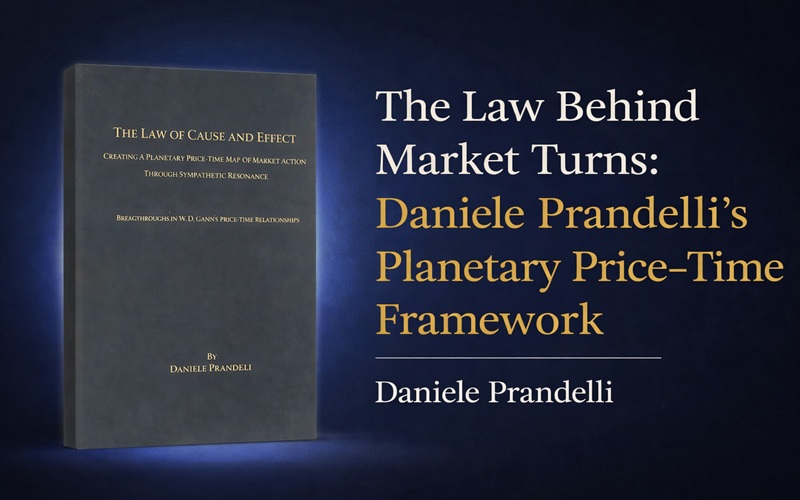
The Law Behind Market Turns: Daniele Prandelli’s Planetary Price–Time Framework
The Foundation
Daniele Prandelli’s The Law of Cause and Effect is positioned as a practical extension of W.D. Gann’s least clearly explained (and most frequently misapplied) concept: Planetary Price Lines. The publisher’s preface frames the core problem bluntly—most attempts fail because the “key” is missing: a usable conversion factor that lets planetary degrees map cleanly onto modern price scales. Without that key, planetary overlays become noise rather than structure.
What makes this work “review-worthy” for serious Gann students is that it is not built as an inspirational manifesto. It is engineered as a toolset: definitions, ratios, conversion logic, and repeatable procedures—supported by examples and documented trade logic. The book also makes clear that the technique is intended to scale beyond the famous 0–360 style charts into markets that trade far above that range (the Dow is explicitly used as an example of a scale problem that defeats simplistic degree plotting).
Core Concepts and Analytical Structure
The book’s internal structure reveals exactly what the author considers “the spine” of the method: Planetary Price → Master Price Cycle → Market-specific ratio determination → Planetary Time → Price/Time merging → research appendices. The Table of Contents is explicit: Planetary Price, Planetary Price Lines, The Master Price Cycle, How to Determine the Ratio for Any Market, then Planetary Time and the integration chapter that merges price with time and trades.
At the technical core is this principle: time is motion, and planetary motion is measured (for this method) primarily through longitude in degrees, then translated into price through a conversion ratio. The book states directly that the approach aims to provide “the means to square price and time” by correlating degrees of planetary motion to any market’s price scale.
From a systems-design perspective, the most important structural element is the Master Cycle concept—because it prevents arbitrary fitting. Prandelli’s method attempts to anchor the market’s dominant degree-cycle behavior first, then project planetary lines accordingly, rather than spraying lines across a chart and selecting what “worked” afterward.
Application and Practical Interpretation
Where most astro-Gann material stalls is the conversion step. Prandelli directly addresses this with a “starting-point” approximation to define a market’s relationship in 360° segments:
Master Cycle approximation formula: (Current Last Price × 0.12) / 360
This is not presented as a final answer; it is a disciplined baseline to select an initial minimum relationship so the chart does not become overpopulated with dense, unreadable line clusters. The book cautions that a ratio that is too small creates too many lines, destroys clarity, and weakens the trader’s ability to isolate true energy levels.
The text then ties ratio selection to a mathematical ladder based on powers (and inverse powers) of 2, reinforcing that the objective is not “creative astrology,” but repeatable harmonic structure.
On the implementation side, the appendices matter: the book provides practical pathways for obtaining ephemeris data and producing the lines—either semi-manually (Excel → calculations) or through charting software—explicitly referencing NASA/JPL Horizons as a data source and describing spreadsheet workflow.
Analytical Reflection
From a reviewer’s standpoint, the book’s real “cause and effect” claim is not mystical: it argues that markets express governing rhythms and that planetary motion—when correctly converted—can identify high-probability price levels and time windows. This is why the method emphasizes confirmation (weekly/monthly reversals) and longer trend capture rather than treating planetary hits as one-bar turning points.
The strength of the work is its insistence on translation: taking Gann’s messy, hard-to-reproduce charts and rebuilding the method in a modern workflow—ratio logic, scaling discipline, and repeatable plotting. Its practical limitation is also clear: the approach demands patience, careful market-specific calibration, and a willingness to validate over many examples rather than chasing immediate “astro signals.”
Conclusion and Further Study
If you want a Gann-adjacent astro text that behaves like a method, not a collection of beliefs, Prandelli’s work is designed for that role. It focuses on the missing engineering layer—how to map degrees to price, how to set the cycle baseline, and how to merge planetary price with planetary time into a structured decision process. The next step after reading is straightforward: pick one market, build the ratio workflow exactly, test several historic swings, then expand to multiple markets and multiple ratios only after the base cycle proves stable.
Recommended further study inside the book’s own ecosystem is the appendices on research tooling and ephemeris handling, because that is where many traders fail operationally—even if they understand the concepts.